Introduction
Selecting the right silicone material is a critical decision for manufacturers in medical devices, automotive components, consumer goods, and industrial applications. The two most common forms—liquid silicone rubber (LSR) and solid silicone rubber (HTV)—offer unique processing methods, mechanical properties, and cost implications.
This blog provides a technical comparison between liquid and solid silicone, helping manufacturers identify the optimal material for their product requirements.
What Are Liquid Silicone and Solid Silicone? Definitions & Chemistry
Liquid Silicone Rubber (LSR)
- Composition: Two-part, platinum-cured, addition-cure elastomer.
- Viscosity: Low, with excellent flow properties for injection molding.
- Processing: Delivered in a pumpable, liquid state, mixed immediately before injection.
- Key Benefit: High precision molding and reproducibility, suitable for automation.
Solid Silicone Rubber (HTV / HCR)
- Composition: High-viscosity, peroxide- or platinum-cured elastomer.
- Form: Supplied as sheets or blocks requiring pre-processing.
- Processing: Typically compression, transfer, or extrusion molded.
- Key Benefit: Versatile, with robust mechanical properties and cost efficiency for less complex parts.
Key Differences in Processing & Manufacturing
Viscosity and Moldability
- LSR: Very low viscosity allows excellent mold filling, even for micro-parts and thin-wall components.
- HTV: High viscosity restricts flow, making it less suitable for complex geometries.
Molding Techniques
- LSR: Requires dedicated injection molding machines, static mixers, and automated dosing.
- HTV: Compatible with compression, transfer, and extrusion molding, offering flexibility with lower tooling investment.
Cycle Times and Automation
- LSR: Short cycle times, high repeatability, and minimal manual intervention—ideal for high-volume production.
- HTV: Longer cycle times, with more labor involvement. Better for medium or low production runs.
Material Properties & Performance Comparison
Mechanical Properties
- LSR: Excellent elasticity, resilience, and tear strength. Maintains properties over repeated stress.
- HTV: High tensile strength and mechanical robustness, particularly suitable for seals and gaskets.
Thermal Resistance & Stability
- Both withstand temperatures from –50°C to +200°C.
- LSR: Superior thermal cycling stability.
- HTV: Strong resistance to static, high-temperature applications.
Transparency and Biocompatibility
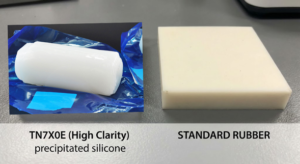
- LSR: Available in optically clear grades, FDA/ISO 10993 certified for medical and food-contact use.
- HTV: More opaque, but still widely used in industrial and automotive applications.
Cost, Scale, and Manufacturing Trade-offs
Material and Tooling Costs
- LSR: Higher tooling and machine investment but lower per-part cost at scale.
- HTV: Lower tooling cost, but higher per-part labor costs due to reduced automation.
Waste and Post-Processing
- LSR: Minimal waste; flash-free molding reduces finishing requirements.
- HTV: Greater potential for flash and trimming, adding secondary operations.
Applications: Where Each Silicone Type Shines
- Liquid Silicone Rubber (LSR):
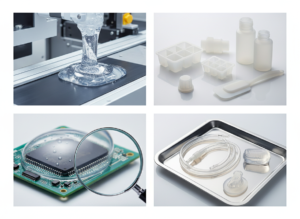
- Medical devices, implants, catheters.
- Food-contact products (baby bottle nipples, bakeware).
- Precision automotive components (seals, valves).
- Solid Silicone Rubber (HTV):
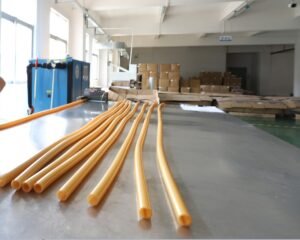
- Extruded tubing, gaskets, and seals.
- High-voltage insulators.
- Automotive hoses and industrial components.
How to Choose Between Liquid and Solid Silicone
When selecting a silicone grade, manufacturers should evaluate:
- Part complexity: LSR for thin-wall, micro, and high-precision parts.
- Production volume: LSR for high-volume automation; HTV for smaller runs.
- Regulatory requirements: LSR for medical and food-grade compliance.
- Cost considerations: HTV for lower tooling costs and less complex geometries.
👉 Partnering with experienced suppliers such as TNSilicone.com ensures access to high-quality materials, technical datasheets, and guidance on selecting the right grade.
Pros & Cons Summary
Liquid Silicone Rubber (LSR):
- ✅ Excellent precision and automation capability.
- ✅ Biocompatible and optically clear options.
- ❌ Higher initial investment.
Solid Silicone Rubber (HTV):
- ✅ Robust mechanical strength.
- ✅ Lower tooling investment.
- ❌ Limited for complex geometries and slower processing.
FAQs
1. What is liquid silicone rubber (LSR)?
LSR is a two-part, platinum-cured elastomer with low viscosity, processed via injection molding for precision and automation.
2. How does solid silicone differ from liquid silicone in strength?
Solid silicone exhibits higher tensile strength, while liquid silicone offers superior tear resistance and flexibility.
3. Is liquid silicone safe for food contact?
Yes, LSR is widely approved for FDA and ISO standards, making it ideal for baby products, kitchenware, and medical devices.
4. Which silicone type is more cost-effective for large-scale production?
LSR becomes more cost-efficient at scale due to automation, while HTV is more economical for small and medium runs.
5. Can solid silicone handle complex geometries?
Not as effectively as LSR. Its high viscosity limits mold filling for thin or intricate designs.
6. Does curing method affect performance?
Yes. Platinum-cured systems (commonly used for LSR) yield higher purity and stability, while peroxide curing (often in HTV) may affect color and extractables.
Conclusion
Both liquid silicone and solid silicone have clear advantages. Manufacturers should align material properties with application requirements, production scale, and regulatory compliance.
By evaluating cost, design complexity, and performance needs, companies can make informed choices—ensuring durable, compliant, and efficient products. For expert guidance, manufacturers can rely on TNSilicone.com for technical support and supply solutions.